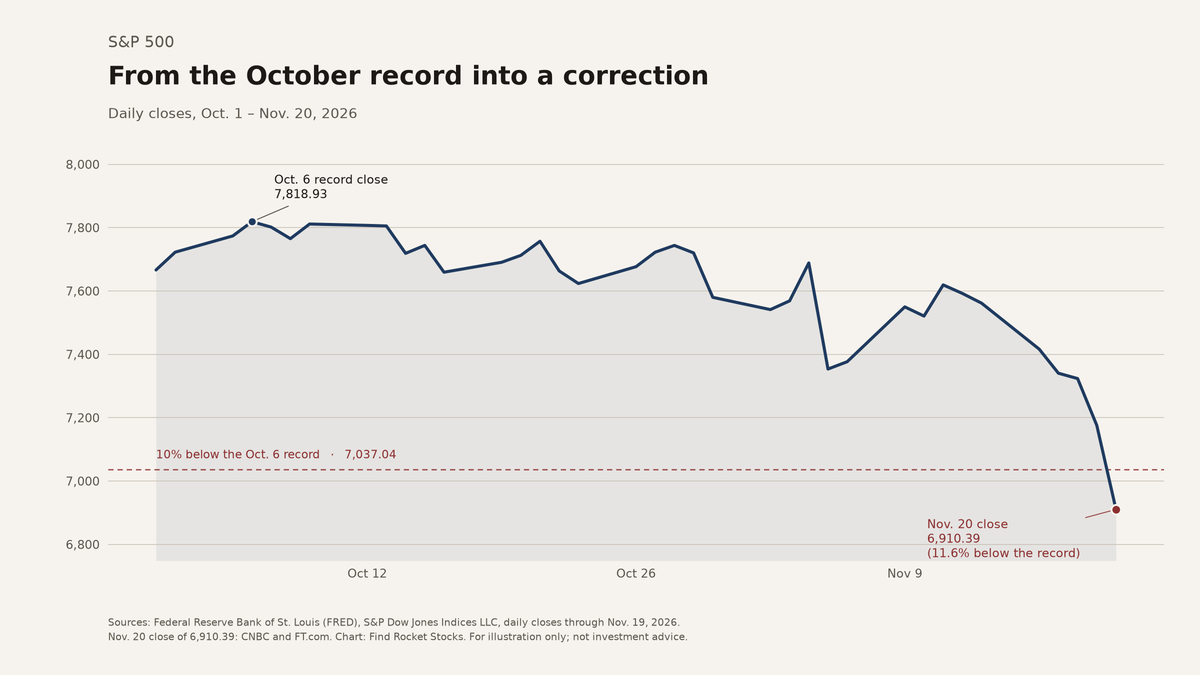
U.S. markets are shut this Sunday, November 22, which is just as well. Friday was the kind of session that usually needs a weekend to sit with. The S&P 500 fell 3.7% to 6,910.39 and closed more than 10% below its record, according to CNBC’s closing recap. That puts the index in a correction. The Dow Jones Industrial Average dropped 949.73 points, or 1.93%, to 48,147.33, and crossed the same line. The Nasdaq Composite slid 5.28% to 22,617.73 and is now down 2.7% for 2026.
This site spent the end of 2025 asking whether the AI boom was running ahead of the cash it was supposed to produce. That question is no longer theoretical. It also is not a green light to call the whole sector finished, or to treat every smashed chip stock as a bargain. The market just took back a lot of the benefit of the doubt it had been giving this trade.
The week was worse than Friday alone
CNBC put the Dow down 8% for the week, its worst showing since March 2020. The Nasdaq lost about 10%, the largest one-week drop in more than six years. The S&P 500 fell 8.6%, its worst week since April 2025, when President Trump’s tariff announcement hit the tape. The Associated Press dated the S&P’s peak to an all-time high on October 6 and noted that the last official correction in the index was March 2025, during the trade-war scare. That record close was 7,818.93, according to CNBC’s October 6 recap and the FRED daily series from S&P Dow Jones Indices. Friday’s 6,910.39 close is 11.6% below that high. NBC News, after Friday’s close, said the S&P’s seven-day losing streak was its worst since the Covid period, and that the index was still up less than 1% on the year. CNBC’s later explainer had it “clinging to a 1% gain.” Either way, the cushion is thin.
The Nasdaq-100 had a nastier intra-day look. CNBC said it fell 5.6% and, at one point, traded 20% below its recent high — bear-market territory before the close. The Cboe Volatility Index, in CNBC’s week-ahead piece, spiked above 30, a level it had not seen since March.
That’s what the market is carrying into a short Thanksgiving week. In Australia, The Australian Financial Review wrote on Sunday that the ASX was primed to open lower, with copper — often used as a stand-in for the AI buildout — down 2.9% on the London Metal Exchange Friday to $12,160 a tonne, its lowest since March. BHP, the world’s largest copper producer, fell 2% in New York Friday.
Anthropic went public. The AI trade still got sold.
The hope last week was that two events would steady AI stocks: Nvidia’s earnings, and Anthropic’s IPO, which CNBC described as the biggest on record. Neither one did the job.
Anthropic priced at $83. On Thursday it traded as high as above $115, then rolled over, CNBC reported in a Saturday-updated explainer. Friday the stock was down another 8.5%, giving back a large piece of that 17% debut pop, and it closed the week at $88.91 — still above the IPO price, nowhere near the first-day high. The company had increased the size of the offering a day before the listing, even as AI stocks were already softening. That is the detail that stuck. To a lot of money, it looked like a cash-out.
CNBC also flagged a slower growth print behind the listing: Anthropic’s third-quarter revenue was up 47%, down from 144% in the second quarter. You can still believe in the product and flinch at that deceleration when the stock is being used as a referendum on the entire trade.
Nvidia is no longer just about the multiple
Chip stocks took the brunt. CNBC said Advanced Micro Devices fell more than 13%, Nvidia around 14%, and Micron almost 14%. Reuters, citing LSEG data, had Nvidia down about 13% on Friday, and noted the stock had already been down more than 6% before Reuters published its report that SEC enforcement staff are scrutinizing potential accounting issues at the company. The SEC declined to comment. Nvidia did not immediately respond. Reuters was careful to say it could not determine when the inquiry began, or which accounting questions are in focus, and that an investigation is not evidence of wrongdoing. That caveat belongs here. The tape still treated the headline as a reason to sell.
The week was already ugly for Nvidia before that story hit. CNBC said the stock dropped 23% for the week, is down nearly 40% in November, and just posted its longest weekly losing streak since the 2008 financial crisis. A solid earnings report on Tuesday did not hold after the board ruled out any return by Jensen Huang, the company’s former chief executive.
Huang’s exit is now part of how the market talks about the AI trade, whether Nvidia shareholders like that or not. Reuters reported he was ousted amid revelations about extramarital relationships, including with Alice Huang, whom U.S. authorities suspect is a Chinese spy — an allegation China has denied. Huang admitted to an affair in a November 8 statement, Reuters said, without naming her. U.S. Justice and Commerce officials said this week they have been investigating Singapore-based Megaspeed, which Alice Huang previously led, over possible export-control violations tied to alleged shipments of Nvidia AI chips to China. Megaspeed has said she left in August 2025 and that it conducted “lawful business.”
There is a lot of smoke in that paragraph and no courtroom verdict. Those are not the same thing. What has changed is simpler: Nvidia is no longer being priced as a clean growth story with a simple leadership narrative. We raised valuation and competitive concerns around the stock late last year in Why Shorting NVDA in Late 2025. The new headlines are different from that piece. The pressure on the shares is not.
The selling did not stay in semiconductors
Massimo Santicchia, head of U.S. equities at Procyon, told CNBC: “This is not just a valuation-driven correction. It’s becoming broader. Right now, it’s definitely risk-off.”
You could see that in the tape. The S&P 500, CNBC said, had already slipped under its 200-day moving average on Tuesday and broke it more convincingly on Thursday — the sort of move that can force trend-following money to keep selling. On Thursday the major averages each lost more than 2%, and the Dow closed below 50,000 for the first time since June.
Money that wanted no part of the AI unwind hid in defensives. Walmart gained more than 1%. Costco, Johnson & Johnson, and Procter & Gamble each rose around 1%. That is not the pattern you usually get from a tidy, self-contained tech shakeout.
Rates were in the mix too. After a quarter-point hike in September, the Fed skipped a move in late October. CNBC reported that the 10-year Treasury yield had jumped above 5% and stayed there until a flight into bonds pulled it back below that level on Friday. Fed Governor Christopher Waller said this week the Fed may need a half-percentage-point increase next month to catch up. “I’m very, very concerned about inflation. It’s kind of headed in the wrong direction, and it’s spreading out,” he told CNBC. Oil, still above $83 a barrel in that same report, and the lingering effect of the Iran conflict, help explain why that worry has not faded.
Richard Saperstein, chief investment officer at Treasury Partners, put the equity side bluntly: the market is going through an “AI repricing,” reflecting slower data-center buildouts, tighter funding for AI projects, and a slower path for technology earnings. That is close to the caution in our December pieces on the AI tech bubble risk and investor worries amid AI hype and Fed uncertainty. Those posts were written when the big indexes were still near highs. The correction has since arrived, and it arrived with catalysts — an IPO used as a cash-out moment, a leadership scandal, a reported SEC accounting probe — that were not on the 2025 scorecard.
CNBC also noted how far some AI-adjacent names had already fallen from their highs: CoreWeave, down 71%; Caterpillar, more than 50%. Those are peak-to-trough figures, not Friday-only moves. They do show that this air has been coming out for a while.
A short week, and one inflation print that will get all the attention
The next regular U.S. session is Monday, November 23. It is a holiday-shortened week. CNBC’s calendar has Wednesday’s October PCE inflation figures — the Fed’s preferred gauge — along with personal income and spending and the second estimate of third-quarter GDP. Thursday the market is closed for Thanksgiving. Friday’s session ends early, at 1:00 p.m. Eastern.
Thin holiday trading can exaggerate whatever Wednesday’s number does. A cooler print could take some heat off the December 9 Federal Reserve meeting. A hot one would feed the concern Waller is already voicing. One report will not settle the bigger argument. Wharton professor Jeremy Siegel told CNBC he sees a reset after investors started treating 15% to 20% annual returns as normal, and his advice was to “stay with your stocks.” Katie Stockton of Fairlead Strategies, on the same network, was less willing to treat the first bounce as a durable low. She has been telling clients not to sell into weakness and, perhaps, to use rallies to reduce exposure — and she is not recommending new long positions right now.
Nobody should be that sure on a Sunday. If you held through the late-2025 warnings on this site, Friday is a reminder that those risks were not abstract. If Friday’s prices have you itching to do something dramatic — dump everything, or double down on the most beaten-up chip names — sit with the calendar first.
Names we’d lean toward — and names we’d leave alone
These are our opinions, based on Friday’s tape and the reporting above. They are not a guarantee, and they are not personal advice. We do not take responsibility for these recommendations. If you buy, sell, short, or hold any of these stocks, that decision — and any gain or loss — is yours. Do your own research, or talk to a qualified advisor, before you act.
Names that held up when the rest of the market didn’t
Money that wanted no part of the AI unwind went into defensives on Friday. One green session is not a lifetime buy rating. It is a read of this tape, and it can fade as quickly as it showed up.
- Walmart (WMT): CNBC said the stock gained more than 1% on Friday, one of the places investors hid when the AI trade was being sold. In a risk-off market, a giant retailer with relatively steady demand is the kind of name that usually gets a bid. That bid is not guaranteed to last through Wednesday’s inflation print, or through a bounce in tech.
- Costco (COST): Rose around 1% on Friday, alongside other consumer staples, while the major indexes were getting hit. Same idea: defensive cash flow, not a momentum story, and not a reason to assume the shares can only go up from here.
- Johnson & Johnson (JNJ): Also up around 1% Friday, per CNBC. Healthcare staples often get a look when growth stocks and rates are the problem. One up day does not make it a hedge for all seasons.
- Procter & Gamble (PG): The other staple CNBC flagged as higher by about 1% on Friday. If the mood stays “don’t fight the Fed, don’t trust the AI multiple,” this is the sort of name that can keep attracting that money. If risk appetite comes back, it can just as easily lag.
Names we would not be chasing
The smashed prices are exactly why some people will want to step in. We would not. The story around these stocks got messier last week, not cleaner, and a bounce in a holiday-shortened week would not change that on its own.
- Nvidia (NVDA): The center of the unwind. CNBC had the stock down around 14% Friday, 23% for the week, and nearly 40% in November, with its longest weekly losing streak since 2008. Reuters reported that SEC staff are looking at possible accounting issues — an inquiry, not a finding of wrongdoing — and the leadership story around Jensen Huang has become part of how the market now prices the shares. We would not treat this dip as a gift.
- Advanced Micro Devices (AMD): Fell more than 13% on Friday, per CNBC, in the same chip-selling wave. If the AI buildout and the funding behind it are being repriced, AMD sits in that blast radius. No need to be a hero here.
- Micron Technology (MU): Dropped almost 14% Friday. Memory has been one of the trades tied to data-center spend. When that spend is questioned, Micron tends to get hit with it.
- CoreWeave (CRWV): CNBC noted the stock is already down 71% from its high and described the company as building data centers with high amounts of debt. That is a long way down, which is precisely why chasing it now is a poor idea. A deep drawdown is not the same thing as a finished decline.
Important Disclaimer
The article provided is for informational and educational purposes only. It represents the author’s opinion and analysis based on publicly available information and does not constitute financial advice, investment recommendation, or an endorsement of any trading strategy, including buying, selling, or shorting any security.
The stocks described above as names we would lean toward, or names we would leave alone, are opinions only. We do not take responsibility for these recommendations, or for any losses, damages, or consequences that may result from acting on them. This is not financial advice. Readers should do their own research or consult a qualified financial advisor before making any investment decision.
We do not suggest, recommend, or advise buying, selling, shorting, or holding any stocks, options, or other financial instruments. All investment decisions carry risk, and you should conduct your own thorough research or consult a qualified financial advisor before making any investment choices.
The author, publisher, and any associated parties are not responsible or liable for any losses, damages, or consequences resulting from actions taken based on the content of this article. Past performance is not indicative of future results, and market conditions can change rapidly.
Investing involves substantial risk, including the potential loss of principal. Please invest responsibly.