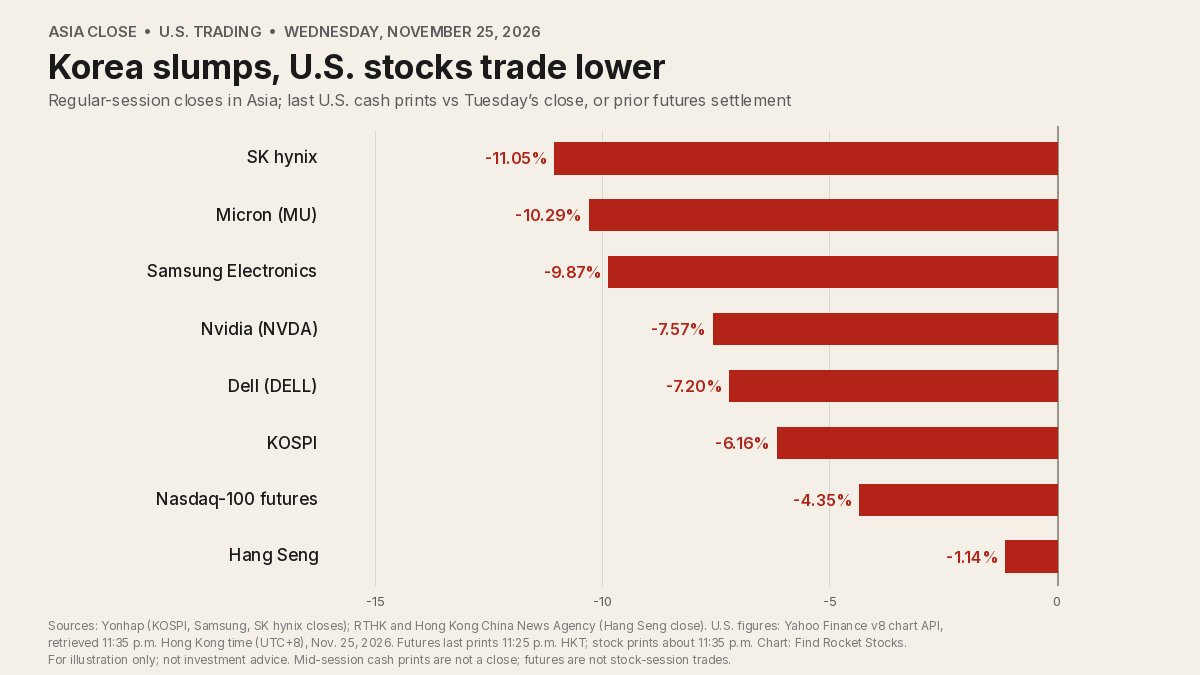
Wednesday, November 25, and the U.S. cash session is underway. The tape is still weaker than the after-hours bounce Dell left behind. The company reported a record third quarter after Tuesday’s close, and the shares finished that extended session at about $297.98, up about 0.92% from the regular close of $295.28. That bid faded in premarket. An earlier Yahoo Finance print at 5:05 p.m. Hong Kong time had Dell at $282.99, down about 4.16%. By 6:22 p.m., the last print was $273.56, down about 7.36%. A later premarket print at 10:09 p.m. was $274.00, down about 7.21%. After the 9:30 a.m. Eastern open, an early print at 10:32 p.m. Hong Kong time was $274.22, down about 7.13%. About an hour into the session, the last print at 11:35 p.m. was $274.01, down about 7.20% from Tuesday’s close.
Asia’s regular session is already finished, and it was ugly in Seoul. The KOSPI closed at 4,697.51, down 308.52 points, or 6.16%, according to Yonhap. Samsung Electronics and SK hynix, the two names that dominate that market, were sold hard. The U.S. Trade Representative has now posted an official notice proposing new Section 301 tariffs on 14 trading partners; those duties are not yet in effect. The October PCE inflation figures are already out, and Thursday the U.S. market is closed for Thanksgiving.
A record quarter is not the same thing as a stock that holds an after-hours bounce. Cash prints can still reverse quickly, and this is already a short week.
Dell already reported a record quarter
Dell’s official release, dated 4:05 p.m. Eastern on Tuesday, is not a preview. The third quarter of fiscal 2027 is out. Revenue was a record $54.937 billion, up 103% from a year earlier. Diluted earnings were a record $8.82 a share, up 287%; non-GAAP diluted earnings were a record $9.45, up 265%. Third-quarter cash flow from operations was a record $4.5 billion.
CNBC’s write-up, citing LSEG, had Wall Street looking for adjusted earnings of $6.59 a share and revenue of $49.32 billion. The print cleared both by a wide margin. Dell also raised its full-year outlook. It now expects fiscal 2027 revenue of $202.0 billion, up 78% year over year, from a prior guide of $192.0 billion, and non-GAAP diluted earnings of $29.68 a share, from $25.50. GAAP diluted earnings guidance was raised to $28.24 from $24.37. For the fourth quarter, the company pointed to revenue of $56.3 billion and non-GAAP diluted earnings of $8.40 a share; CNBC, again citing LSEG, said analysts had been looking for $7.50 a share on $53.61 billion in revenue.
The growth sat in Infrastructure Solutions Group. Officially, ISG revenue was a record $41.974 billion, up 198%. AI-optimized servers were $22.031 billion, up 291%. Traditional servers and networking were $15.013 billion, up 235%. Storage was $4.930 billion, up 24%. ISG operating income was a record $7.118 billion, up 308%. Jeff Clarke, the vice chairman and chief operating officer, said the company ended the quarter with a record $132.3 billion AI backlog after booking $60.2 billion of orders, “each rigorously vetted for customer quality and access to capital, land and power.” Full-year AI-optimized server revenue guidance was raised to $78.0 billion from $74.0 billion.
The soft spot was Client Solutions Group, which is the PC and laptop business. CSG revenue was $12.886 billion, up 3% year over year. Operating income was $704 million, down 6%. CNBC, citing LSEG, said the sales line missed a $14.33 billion estimate. That miss does not erase the infrastructure print. It is a reason not to treat the whole report as a clean sweep. Backlog, as this site has said before, is not revenue until it ships. The official numbers show a lot of that backlog is now being billed. They do not, on their own, tell you how the stock will trade into a short week.
The after-hours bounce did not last
Tuesday’s cash close already told you the market was in no mood to give hardware the benefit of the doubt into the release. Dell finished the regular session at $295.28, down about 11.83% from Monday’s close of $334.91. The Nasdaq Composite closed at 23,733.54, down about 1.48%. The S&P 500 finished at 7,201.09, down about 0.50%. The Dow was the exception, up 423.39 points, or 0.85%, to 50,018.70, according to Reuters, as carried by NBC News, matching Yahoo Finance.
After the release, the shares bounced. Some early evening headlines caught a higher after-hours print and wrote that the stock was up about 4%, or nearly 5%. We’re not using those as the live quote. The last print at the end of the 8:00 p.m. Eastern session, at 8:59 a.m. Hong Kong time on Wednesday, was about $297.98, up about 0.92% from the cash close. That’s the bounce that mattered, and it was modest.
U.S. premarket trading began at 4:00 a.m. Eastern, which is 5:00 p.m. in Hong Kong. The first minutes were jumpy. Yahoo’s one-minute chart showed Dell at $289.33 at 5:00 p.m., $296.00 at 5:01, then $280.01 at 5:02. Equity premarket volume fields on that feed printed as zero, which is a reminder that these ticks can be thin. The 5:05 p.m. print of $282.99, down about 4.16%, was already a fade from the after-hours close. By 6:22 p.m. Hong Kong time, the last print was $273.56, down about 7.36%. A later premarket print at 10:09 p.m. was $274.00, down about 7.21%. The U.S. cash session opened at 9:30 a.m. Eastern, 10:30 p.m. in Hong Kong. The opening minute printed at about $271.34, and an early print at 10:32 p.m. was $274.22, down about 7.13%. About an hour into the session, the last print at 11:35 p.m. was $274.01, down about 7.20% from Tuesday’s close. A record sales number can still be sold if the market is more interested in the next risk — a soft client business, Korea, tariff headlines, or just a short week — than in the beat itself.
Korea’s close was the day’s loudest regular-session move
Yonhap said the KOSPI reversed the previous session’s rally, falling as low as 4,672.55 before ending at 4,697.51, down 308.52 points, or 6.16%. The index dropped below 5,000 in a single session. Earlier in the day, the Korea Exchange activated a sell-side sidecar at 9:09 a.m. Seoul time, briefly suspending buy orders in program trading after KOSPI 200 futures fell far enough to trip the rule. Foreigners were net sellers of 1.9 trillion won, Yonhap said; institutions sold a net 75 billion won, while individuals bought a net 1.4 trillion won.
The selling was concentrated in the chip names that carry that market. Samsung Electronics closed at 170,700 won, down about 9.87%. SK hynix closed at 1.03 million won, down about 11.05%. The Korea Times described the same session as a 6% slide, and said investor sentiment was also weighed down by talk of a new wave of U.S. tariffs. Those are closing prices, not early U.S. ticks. They were also the backdrop U.S. traders walked into when the cash session opened.
Hong Kong finished lower too, if less violently. RTHK said the Hang Seng Index closed at 21,966, down 253 points, or 1.14%, below the 22,000 mark, and called it a seventh straight down day and a low of more than a year and a half. Hong Kong China News Agency had the same close as 21,966.01, down 253.64 points, or 1.14%. Japan’s Nikkei 225 finished at 57,011.62, down about 2.78%, according to Nikkei and Yahoo Finance. We’re not using mid-session Asia figures from Western live blogs that didn’t match these closes.
Futures and the AI-hardware names were still being sold
The U.S. tape is still weaker about an hour into the cash session. Nasdaq-100 futures last printed at 25,132.00 at 11:25 p.m. Hong Kong time, down about 4.35% from the prior settlement of 26,275.75, according to Yahoo Finance’s v8 chart data retrieved at 11:35 p.m. S&P 500 futures were at 7,013.25, down about 2.83% from 7,217.50. Dow futures were at 49,184, down about 1.75% from 50,061.
Those are last prints versus settlement, not a cash-session close. They were also softer than earlier snapshots. Around 4:55 p.m. Hong Kong time, S&P 500 futures were at 7,154.75, down about 0.87%, and Nasdaq-100 futures were at 25,813.50, down about 1.76%. By 6:12 p.m., those contracts were at 7,111.25, down about 1.47%, and 25,631.00, down about 2.45%. An early cash-session print at 10:22 p.m. had S&P 500 futures at 7,065.25, down about 2.11%, and Nasdaq-100 futures at 25,425.25, down about 3.24%. CNBC’s live blog, updated at 5:17 a.m. Eastern — 6:17 p.m. in Hong Kong — had the same direction at that earlier hour: S&P 500 futures down 1.4%, Nasdaq-100 futures down 2.3%, and Dow futures down 391 points, or 0.8%.
Single-stock trading followed the hardware script deeper into the cash session. Nvidia last printed at $143.62 at 11:35 p.m. Hong Kong time, down about 7.57% from Tuesday’s regular close of $155.38. Advanced Micro Devices was at $377.40, down about 8.68% from $413.27. Micron was at $564.96, down about 10.29% from $629.79. Hewlett Packard Enterprise, which already warned about AI-server margins after Monday’s close, last printed at $38.73, down about 3.63% from Tuesday’s close of $40.19.
This is the same trade this site wrote about on Sunday, when the S&P 500 and the Dow had closed in a correction and the Nasdaq Composite had erased its gain for 2026. Dell’s beat does not close that argument by itself. It shows the market can still sell an AI-infrastructure name after a record quarter, especially when Seoul has already had a 6% day, the inflation print is already out, and tariff headlines are still in the market.
The PCE print is out, USTR has proposed tariffs, and it’s a short week
The tariff story is now an official proposal, not an enacted levy. Earlier Wednesday, the Associated Press and the BBC described plans that had not yet been announced. Later in the New York morning, Politico and CNBC reported that the administration had laid out proposed Section 301 tariffs on 14 trading partners. The U.S. Trade Representative has since posted a formal notice: Ambassador Jamieson Greer determined that the practices of 14 economies relating to structural excess capacity and production in manufacturing are actionable under Section 301(b), and has proposed additional tariffs for public comment. The 14 economies named in the release are China, the European Union, Singapore, Switzerland, Indonesia, Malaysia, Cambodia, Thailand, Korea, Vietnam, Taiwan, Bangladesh, Japan, and India. USTR said it has not made determinations with respect to Mexico or Norway at this time. Written comments and requests to appear at the hearings are due by January 5, 2027, and hearings are scheduled for January 25, 2027. Until that process is finished and a final action is taken, the duties are not in force.
The data that was due at 8:30 a.m. Eastern, about 9:30 p.m. in Hong Kong, is now out. The Bureau of Economic Analysis said the October PCE price index, the Federal Reserve’s preferred inflation gauge, rose 0.3% from the prior month and 3.8% from a year earlier. Excluding food and energy, the index also rose 0.3% on the month and 3.3% from a year earlier. The headline reading matched what CNBC had said economists polled by Dow Jones were expecting — 0.3% for the month and 3.8% from a year earlier. The core year-over-year rate came in a tenth of a point above that survey’s 3.2% forecast, according to CNBC’s write-up of the report. Personal income increased 0.7% in October, and current-dollar PCE spending increased 0.3%, the bureau said. The same release put the personal saving rate at 4.1%. In a separate report, BEA’s second estimate said real GDP increased at a 4.3% annual rate in the third quarter, revised up 0.9 percentage point from the 3.4% advance estimate. Weekly jobless claims, arriving a day early because of the holiday, fell to 189,000 in the week ending November 21, the Labor Department said, down 13,000 from the prior week’s revised 202,000. Thursday the market is closed for Thanksgiving. Friday’s session ends early, at 1:00 p.m. Eastern.
Thin holiday trading can exaggerate these moves, and an inflation print that is already in the market. A hardware selloff can stall. A defensive bid can fade. Neither would settle the larger argument about the AI trade, and neither would make a mid-session print look like a close.
Tuesday’s retailer beats are still on the tape
Best Buy and Dick’s Sporting Goods already reported before Tuesday’s open, beat what Wall Street was looking for, and raised guidance. Those official figures have not changed. Best Buy’s release still shows enterprise comparable sales up 6.1%, adjusted diluted earnings of $1.62 a share, and a higher full-year outlook. The shares closed Tuesday at $99.62, up about 2.70% from Monday’s close of $97.00. In Wednesday’s cash session, an 11:35 p.m. Hong Kong print was $100.21, up about 0.59% from Tuesday’s close.
Two retailer beats on Tuesday morning don’t rewrite Wednesday’s hardware tape. They’re just two companies, already in the books, heading into the same short week.
If you’re tempted to treat Dell’s raise as proof the AI-server cycle is back in the market’s good graces, or Korea’s close as a permanent verdict, sit with the calendar first. The rest of the cash session can still change the story.
Names we’d lean toward — and names we’d leave alone
These are our opinions, based on Tuesday’s official reports, Wednesday’s Asia closes, and the cash tape above. They are not a guarantee, and they are not personal advice. We do not take responsibility for these recommendations. If you buy, sell, short, or hold any of these stocks, that decision — and any gain or loss — is yours. Do your own research, or talk to a qualified advisor, before you act.
Names that are not the center of this selloff
A clean consumer print, or a modest bid in a defensive name, is a better starting point than a hope that the hardware complex has finished going down. That isn’t a lifetime buy rating, and it’s a poor reason to chase a thin holiday tick.
- Best Buy (BBY): The official print is still clean: comparable sales up 6.1%, the highest in five years, adjusted earnings of $1.62 a share versus a $1.49 LSEG estimate, and a raised full-year outlook. Tuesday’s regular close held a gain of about 2.70%. The later cash print, at $100.21 as of 11:35 p.m. Hong Kong time, was slightly higher. We’d rather read that as a vote for a quarter already in the books than as an invitation to trade a thin holiday session.
- Walmart (WMT): Last printed at $132.09 at 11:35 p.m. Hong Kong time, down about 0.17% from Tuesday’s close of $132.31. CNBC’s live blog, quoting Deutsche Bank’s Jim Reid, pointed to a rotation toward defensive sectors such as healthcare and consumer staples rather than the indiscriminate selling of last week. One modest bid is not a hedge for all seasons, and it can disappear as quickly as it showed up.
- Johnson & Johnson (JNJ): Last printed at $276.24 at 11:35 p.m. Hong Kong time, little changed from Tuesday’s close of $276.46, down about 0.08%, after an earlier premarket bid had been firmer. Healthcare staples often get a look when growth stocks and trade headlines are the problem. That look is not guaranteed to last through the rest of the session, or through a bounce in tech.
Names we would not be chasing
The weaker prices are exactly why some people will want to step in after Dell’s beat. We wouldn’t. The record quarter is already out, the bounce has already faded, and a holiday session won’t settle the rest of the tape.
- Dell (DELL): The official numbers were strong: record revenue of $54.937 billion, non-GAAP earnings of $9.45 a share versus a $6.59 LSEG estimate, and a raised full-year sales guide of $202.0 billion. The stock still closed Tuesday at $295.28, down about 11.83%, managed only a 0.92% after-hours bounce, and was last at $274.01 in cash trading, down about 7.20%. A beaten-up price after a beat is not the same thing as a finished decline. The Client Solutions miss, the Korea close, and the tariff headlines are all still in the market.
- Nvidia (NVDA): Still the center of the AI unwind this site described on Sunday. The later cash print was $143.62, down about 7.57% from Tuesday’s close of $155.38, after a regular-session drop of about 5.86% on Tuesday. Dell is a large buyer of the AI-server stack, and CNBC noted that Dell’s infrastructure systems are often built around chips from companies such as Nvidia and AMD. That linkage is precisely why we wouldn’t treat this dip as a gift.
- Advanced Micro Devices (AMD): Last printed at $377.40, down about 8.68% from Tuesday’s close, in the same wave as Nvidia. If the market is still repricing the AI buildout, or still trading every hardware print as a referendum on that trade, AMD sits in that blast radius. No need to be a hero into a short week.
- Micron Technology (MU): Last printed at $564.96, down about 10.29%. Memory has been one of the trades tied to data-center spend, and Wednesday’s Seoul session showed how quickly that trade can be sold when the chip outlook and tariff talk share the same tape. When that spend is questioned, Micron tends to get hit with it.
Important Disclaimer
The article provided is for informational and educational purposes only. It represents the author’s opinion and analysis based on publicly available information and does not constitute financial advice, investment recommendation, or an endorsement of any trading strategy, including buying, selling, or shorting any security.
The stocks described above as names we would lean toward, or names we would leave alone, are opinions only. We do not take responsibility for these recommendations, or for any losses, damages, or consequences that may result from acting on them. This is not financial advice. Readers should do their own research or consult a qualified financial advisor before making any investment decision.
We do not suggest, recommend, or advise buying, selling, shorting, or holding any stocks, options, or other financial instruments. All investment decisions carry risk, and you should conduct your own thorough research or consult a qualified financial advisor before making any investment choices.
The author, publisher, and any associated parties are not responsible or liable for any losses, damages, or consequences resulting from actions taken based on the content of this article. Past performance is not indicative of future results, and market conditions can change rapidly.
Investing involves substantial risk, including the potential loss of principal. Please invest responsibly.